Sin and cinema: A review on “The Devils”
By Alfie Eville
Back in 1971, British filmmaker Ken Russell released one of the most controversial movies ever made. “The Devils” follows Sister Jeanne, a physically deformed and religiously devout woman, shelled in by her coventry with little exposure to the outside world. That little exposure is through a gated window tucked away in her quarters. Through it, she sees Father Urbain Grandier, a strong and sexually appealing man. A man so captivating, she becomes obsessed. These obsessions haunt her, devolving into the sin of lust.
The two lead characters each have their sins, despite their religious devotion. Grandier, played expertly by Oliver Reed, so easily gives in to his sinful ways, even justifying it to a lover of his. Sister Jeanne is on the opposite side of the spectrum, as she perseverates over these lustful visions, struggling to repress them. Russell shows this dichotomy visually through Grandier being a proud and handsome man, while Sister Jeanne struggles with a humpback, destroying her posture and making her both literally and figuratively “crooked.”
The film is based on a book by Aldous Huxley, “The Devils of Loudun,” as well as a stage play by John Whiten that shares the same name as the film. But more importantly, the nuns of Loudun were real people, as well as Grandier. The “possession” of them did occur, but Russell chooses not to frame it in a religious manner, as it is instead much more grounded. The film chalks the events up to mass hysteria.
Watching the film and its characters slowly devolve into irrationality and absurdism is poetic and horrific. Sister Jeanne, going from personal fits, sexual frustration and visions of Grandier, devolves into publicly declaring herself to be possessed and the fault be put on Father Grandier. And, unbeknownst to all of this, is Grandier himself, who is newly married and has worked to move past his adultery and sin.
This is one of my favorite aspects of the entire movie, as the character who began so openly immoral with his sexual habits is able to easily move past it and confront it. He is able to confront it because he is aware of it and accepts it. Sister Jeanne, once again, opposes this viewpoint, as she begins the film pure, but her sexual celibacy consumes and corrupts her; not dissimilar to the ways of the devil. The themes of “The Devils” are riveting. As a person who is not religious, I am still able to appreciate every biblical aspect, as well as grounded hysterical points. Calling the movie poignant would be a deeply offensive understatement, as after seeing it for the first time one week ago, I have not once stopped thinking about it.
Additionally, while I am not Catholic — so perhaps I am not the best messenger for this — I do not find this movie inherently blasphemous or heretical. The actions in the film absolutely fall under that category, but the message does not promote devil-worshipping or anything of the sort. It is important to remember that inclusion does not equal endorsement. This film is a cautionary tale of authority lording over the weak, taking advantage of women and the spreading of rumors and tall tales for the sake of personal profit. The abuse that Sister Jeanne undergoes is horrific, and her fall from grace is painfully disturbing. The way her vulnerability is taken advantage of is vile; the devil corrupts the ones that say they work in the name of God in this film.
Graphic by Grace Juarez
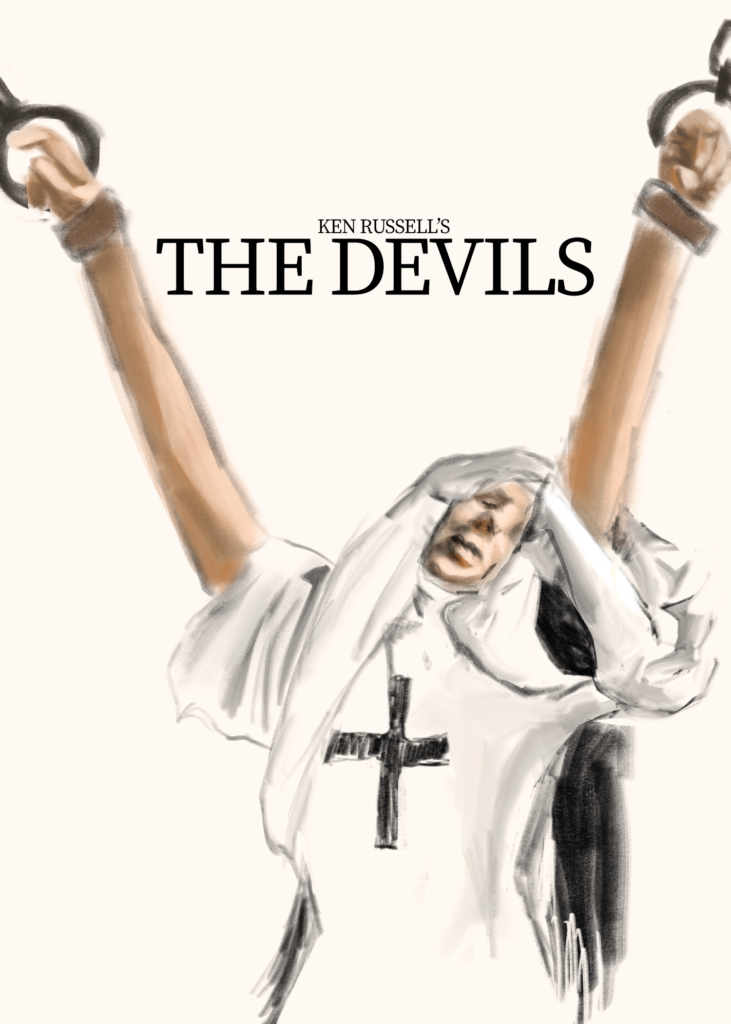
I will strongly attest to the fact that this is a perfect film. I was captivated from the moment the film started to its end. My mouth was agape for much of the runtime. It is a technical marvel, as the set pieces are astonishing; the lifeless brick walls, the tall castles. The Ursuline sisters’ coventry is perfect with its white walls and floors, which perfectly match their eggshell-white habits with that iconic cross down the middle of their chests. On top of that, the acting is some of the best ever, especially Reed. He dominates every frame he is in and is the only actor worthy of playing Father Grandier. Redgrave in the role of Sister Jeanne is harrowing and will be a performance that lives with me for the rest of my life.
The way the director is able to so effortlessly weave between these two separate lives impresses me and should be noted by any aspiring writer or director.
It must be noted, however, that there are two distinct versions of this film: the theatrical cut and the director’s. The theatrical cut has always been extremely difficult to come by, as it is not on any streaming services, and few DVDs are made of it. But for decades, the director’s cut was impossible to watch, as the cut footage was so challenging to find. Luckily for audiences, Clockwork, a sister company of Warner Bros., restored the film and uncensored those additional six minutes. This is how Russell wanted his vision to be seen, and this restoration makes the film flow so much better. This story should never have been censored, as it barred audiences for many years from seeing such an improved version.
That being said, I do fully understand why the ban was put on “The Devils.” There are graphic depictions of devil worship, grotesque and drawn-out scenes of nuns engaging in sexual acts, as well defiling the cross and much more. Audiences back in 1971 were expectedly not ready for content this obscene, which is why the film was so quickly given an NC-17 rating before having to be trimmed down. Even to audiences today, some scenes are especially hard to swallow: depictions of nuns engaging in an orgy at church could be extremely upsetting for Catholics, as well as non-Christians. This scene, along with others, still to this day push boundaries. It makes sense back then to have censored these absurd scenes, but we live in a time now where this film should and finally is being shown off in full, finished form.
In regards to these heavy censorship and bans, I dislike it. While it may be controversial, there is nothing illegal about the film; banning art should never be the solution. And while I can understand the censorship for the time, I think modern audiences have evolved to be able to stomach content like this. I truly hope that this film’s rerelease in 2026 will invite a new generation of fans for this film, the genre of exploitation — specifically nunsploitation — as well as new fans for controversial media in general.
Art, especially when it is of this high quality, should never be tampered with. Clouding and cutting the director’s vision in any way only ruins the final project, as is evident with this film in specific. Let art be free and on full display. Ken Russell’s “The Devils” was released in 1971, and after 55 years, it is finally being appreciated. It is the best film to come out in 2026 and 1971. A landmark that has stood the test of time, and is thus rewarded five holy stars out of five.
Alfie Eville is a sophomore history and secondary education major