Provost reimagines Teaching and Learning Collective to enhance student and faculty experiences
By Samantha Clark
This story was updated on Sept. 9.
Rider’s Teaching and Learning Center has been reimagined into the Teaching and Learning Collective, which now follows a faculty-led structure, allowing all professors involved to collaborate across disciplines, reshape how they educate and develop courses to best assist their students.
Building better educators
In previous years, the Teaching and Learning Center allowed Rider faculty members to learn key skills in a classroom-like setting. These skills could then be brought into Rider’s classrooms, leading to faculty development and multifaceted coursework.
However, as Rider President John Loyack began to restructure the university, Provost and Senior Vice President of Academic Affairs Kelly Bidle made a plan to reorganize the Center, as well, reimagining what faculty development should look like.
The new model, now known as the Teaching and Learning Collective, follows four main pillars of development.
According to the Collective’s informational page, the pillars include Teaching with Emerging Technology, Responsive Pedagogies for Student Success, Scholarship of Teaching and Learning and Professional Development, and High-Impact Teaching and Experiential Learning.
Each pillar urges professors to look at new innovations in education and use them to their advantage in the classroom to better guide students through their coursework.
Bidle also emphasized the importance of a faculty-led structure, which lets professors learn from and alongside one another. With this, she set a plan to rotate the program’s leadership, which would now consist of two Rider faculty members, every two years.
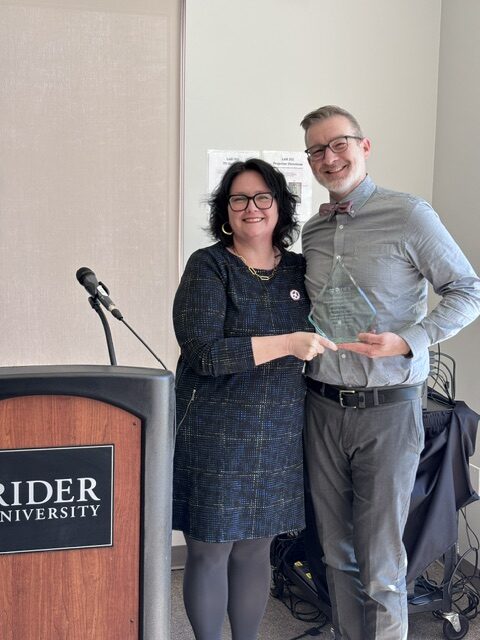
For the inaugural co-directors of the Collective, Bidle selected Erica Ryan, a professor and director of the Gender and Sexuality Studies Program, and Justin Burton, a professor in the Department of Media Arts.
“The Provost reached out to Justin and I at the end of last academic year and said … that we need to bring a robust faculty development program back into the picture,” Ryan said. “There’s a clear indication that this new direction is an investment in faculty becoming better teachers, not only for themselves, but for the students.”
As co-directors, Ryan and Burton will shape the Collective’s structure and choose programming for each learning community, a cohort of six to 10 faculty members who explore the selected topic and learn from one another.
“The work we’re doing is because we want to do our work well,” Burton said. “The university is trusting faculty to know how to lead the way on this.”
Inside the communities
As the inaugural co-directors, Ryan and Burton selected three faculty learning communities, two that focus on the use of artificial intelligence in the classroom and one that centers around first-generation college students, which coincides with the emphasis placed in Loyack’s March to Sustainability Plan.
Laurel Harris, an associate English professor, is leading the Rider Critical AI Collaboratory, which explores the use of artificial intelligence in higher education from a philosophical standpoint.
Faculty members will consider how teaching and studying English, philosophy, history and the social sciences are changing now that students have access to technology that is capable of thinking for them.
Redesigning Courses in the Age of AI, the second AI-focused community, is led by Federica Rossetti, an assistant professor of marketing.
Exploring how to engage with AI responsibly, this learning community will look at a more practical approach to technology, which allows professors to help students maintain their critical-thinking skills and create authentic work while using technological assistance.
“Whenever we have a new technology that comes, it can be difficult, so I think it’s really important for faculty to really take stock of what it is and what it means for us and the work we do,” Burton said.
Assistant Professor of Spanish and Latinx Studies Cynthia Martinez’s community, titled “Becoming ‘New Jersey’s Hub for First-Generation Students’: What Faculty Can Do,” explores how Rider can best assist these students, both during and after college.
Examining the practical challenges that
first-generation students experience when arriving on campus, the community aims to educate faculty on how institutions can best serve students after graduation through experiential learning, hands-on opportunities and concrete work experience.
“One of [Loyack’s] big pushes is for Rider to think of itself as a hub for first-generation college students. A lot of us are really excited about that. … Being able to serve first-generation students is a privilege,” Burton said.
An investment in education
While the learning communities place a new importance on faculty development, the shift from the Center to the Collective also brings a renewed commitment to funding.
“In the last five years or so, the university stopped funding faculty participation in this kind of thing,” Ryan said. “When [Bidle] came up with this new version, she felt, and we agreed, that we need to bring that [funding] back.”
Instructors involved in each community will now be compensated for their participation, reinforcing the university’s devotion to faculty development and the future of their students.
Ryan said, “I think it is really exciting that Rider is turning this corner and getting to a place of financial stability, and is bringing everybody along with that.”
Additionally, professors’ involvement is an investment in the Rider community, as the Collective allows faculty to learn from peers who approach teaching differently, it combines various departments, backgrounds and concentrations.
“As a faculty member, it’s easy to be in your silo … You teach your classes, you’re in a department, you see your colleagues,” Ryan said. “These learning communities are diverse in terms of hitting all of the colleges on campus, hitting people from disparate fields. So, it fosters a sense of community broadly among faculty.”
At the heart of the Teaching and Learning Collective though, is the commitment to students, with the ultimate goal of ensuring that the investment in faculty development translates into stronger courses, more engaging learning and an overall better student experience.
“If faculty development is working well, it’s mostly never thought about by students,” Burton said. “It will show up as them being satisfied with their classes, feeling that their professors are responsive and [thoughtful] and, just in general, what they are learning is relevant to their lives and their future careers.”