
Nathan Fielder lets us see everything
By Alfie Eville
In my time of being a movie fan, I have looked forward to plenty of releases. Many anticipated projects have come and gone, meeting, exceeding or falling short of expectations. In the past few months, I would argue there has not been a film more anticipated in my life than “You Can See Everything.” The film is a three-hour documentary on Elizabeth Holmes, founder and Chief Executive Officer of Theranos, a defunct company, found guilty of defrauding investors and patients. On the other side of this is Nathan Fielder. A well-known comedian, known famous for his early 2010s show “Nathan For You,” wherein he visits and helps struggling businesses with bizarre and out-there ideas. An important note about Fielder is that he is always playing a version of himself. A character that is an overly serious and awkward individual, which aids in these over-the-top scenarios he finds himself in. It is a sort of Philomena Cunk archetype, if you will.
So knowing that these two were being paired together for this documentary — which would be her first public appearance since 2016 — set my expectations higher than they had ever been. And they only grew when, by Oct. 18, the third day of the movie’s release, the film garnered a 100% on Rotten Tomatoes, a 98 on Metacritic, and most impressively, a 4.8 on Letterboxd, the highest-rated film ever on the platform. With all that being said, I am still shocked to say: the film outdid these expectations, and might arguably be the greatest film I will ever have the privilege of writing about.
While the title of this movie is “You Can See Everything,” that does not mean that you know anything. Fielder and co-director Lance Oppenheim give us a first-hand look into Holmes’ last month before being sentenced to federal prison. They record everything. No conversations are left censored, Holmes had no creative liberties in any of this. That being said, this documentary does not give us any concrete answers. The film calls out other documentaries, and itself, with a core theme being that no documentary can inherently be unbiased. The audience is guided mostly through Fielder’s perspective, and he is in no way impartial. There are some parts where it is entirely just his memory and his retelling of events. We are left to either accept it and buy into the film’s bias, or question it. While documentaries, this one included, are attempting to give an objective look, we will always see it through the lens of someone else’s camera, another person’s script and another’s personal perspective. Can we see everything? Yes. But is what we are seeing the truth? That is the core question behind this documentary.
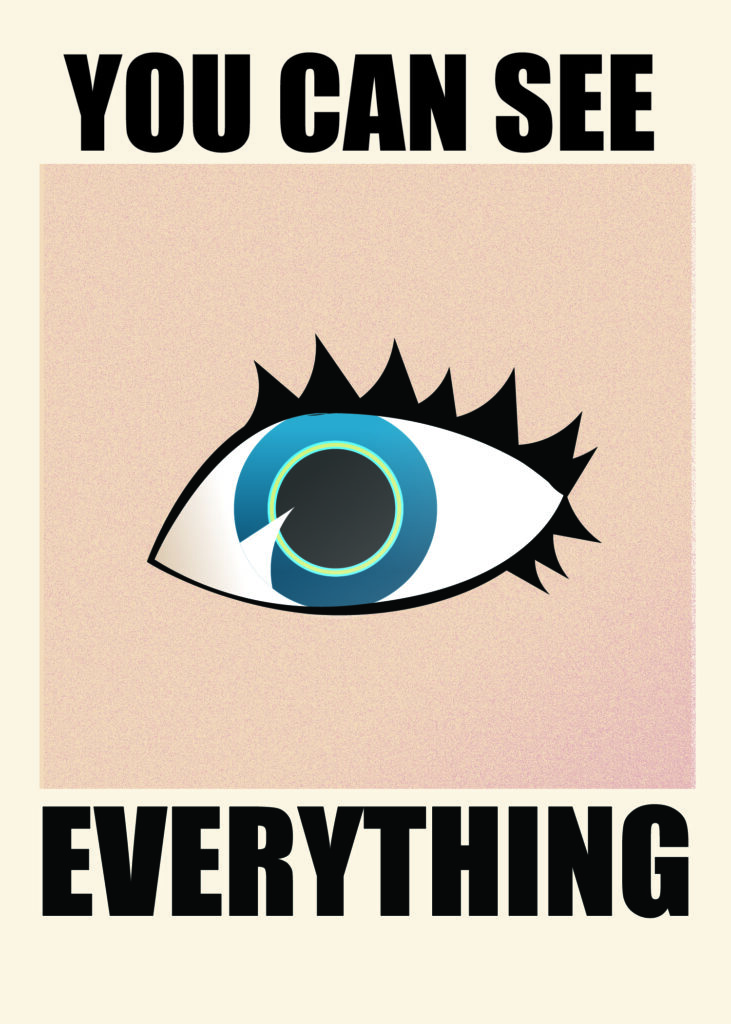
Graphic by Grace Juarez
This is so much more than just a straight-forward showcase of Holmes’ life before jail. There are messages of power, corruption, manipulation and media/documentation all throughout the three-hour runtime. I believe that, if this was just some regular documentary made by a regular old journalist, or done in a “60 Minutes” way, it would flop. It would not be groundbreaking or entertaining in the slightest. Fielder is the man that makes this film truly historical.
You may ask, what is so special about a comedian? Why is he so relevant? Well, I think it is due to him playing a character. Fielder is a master at social engineering. He knows exactly how to play his part to get what he wants out of others. This is on full display here, as he so effortlessly drags information out of Holmes and her husband Billy Evans. Be it through silence, flattery or sheer manipulation, he does more than most expert journalists could do. His genius is on full display in this documentary. After all, he did graduate from one of Canada’s top business schools with really good grades.
Let us now talk about the other manipulator in the film. Holmes is no stranger to social engineering, just like Fielder. She revamped her public appearance to align herself with other tech figures like Steve Jobs. The black turtlenecks, the deep masculine voice, these are all iconic things that most people know her for. But in this movie, everything is different. She is a mother and makes that painfully obvious, with most shots of her having her baby either in her arms, being breastfed or rocked and cradled. Many segments have her being incredibly submissive and fragile, especially when with Evans, her husband. It almost appears that she is being taken advantage of in some way or another by him. One could interpret this as being true. After all, Evans is in no way a saint, for he is quite the narcissist. Add on that people believe her prior boyfriend and Chief Operating Officer of Theranos, Sunny Balwani, lorded over her and was the one taking part in the fraud, not her, the narrative around this makes sense. However, this could all just be done purposefully, to make her seem more innocent than she really is. It is not a stretch to say the lying, convicted fraud is pretty good at manipulating and reshaping her public image.
In the end, we do not get any answers. Everything is left up to the audience to decide. Some will call for Holmes’ head on a stick, believing that this is more proof of her misdeeds and borderline psychopathy. Others will see a misguided and abused woman, too young to have realized the bad things going on at her company; so innocent and focused. After all, she had only wanted to help people. A woman who still, to this day, only cares about helping others, but finds herself trapped, once again, by a sick and twisted man.
When the central story has three characters, all of whom are in some way lying or deceiving, no answers can be had. It is horrifying that three hours passed, and I have more questions than answers regarding Elizabeth Holmes, her husband Billy Evans and what really went on at Theranos. All I know for sure is that Fielder has come a long way, from being offered to sniff a five year old’s pee, to crafting the greatest look into someone’s psyche. He caught lightning in a bottle with “You Can See Everything.”
I do not know why, but I love Elizabeth Holmes. Not because she is a good person, but in a more macabre, fascinating way. Her weirdness, mixed with her being a pathological liar, who to this day, stands by her innocence, intrigues me so much. Couple that with my longtime love for the show “Nathan For You,” and you get one of my favorite projects of all time. I could easily talk about this film for hours. I have already seen it twice in theaters and have plans on seeing it at least two more times. It is the textbook definition of perfect, and not only gets the full five stars out of five, but supplants itself firmly in my top four favorite films of all time for right now.
Alfie Eville is a sophomore history and secondary education major