Enrollment dwindles, Rider community at odds
By Grace Bertrand
Rider is set to run out of cash by April 1, 2026, while immediate actions from the March to Sustainability Plan aim to reduce spending by $15.7 million, according to Interim Chief Financial Officer Thomas Papa.
Rider’s debt currently sits at $130 million, with $15.7 million due between March and June of 2026, with a 12.5% interest rate.
Rider’s time-sensitive financial situation was discussed in a faculty and staff forum on Nov. 13 hosted by Rider President John Loyack, Papa, Board of Trustees Chair Joe McDougall and Provost Kelly Bidle, where the administration addressed various concerns employees had about the Plan.
“When you don’t have enough cash to pay your bills, you have to breach that gap, and all of the strategies of the past that have happened — borrowing from the endowment, taking out more debt — that all goes to solve that hole,” Papa said at the faculty and staff forum.
Following months of silence, Loyack released enrollment and budget statistics, projecting an operating budget cash deficit of $4.7 million for fiscal year 2026, according to a full copy of the March to Sustainability Plan which was released in a Nov. 12 universitywide email.
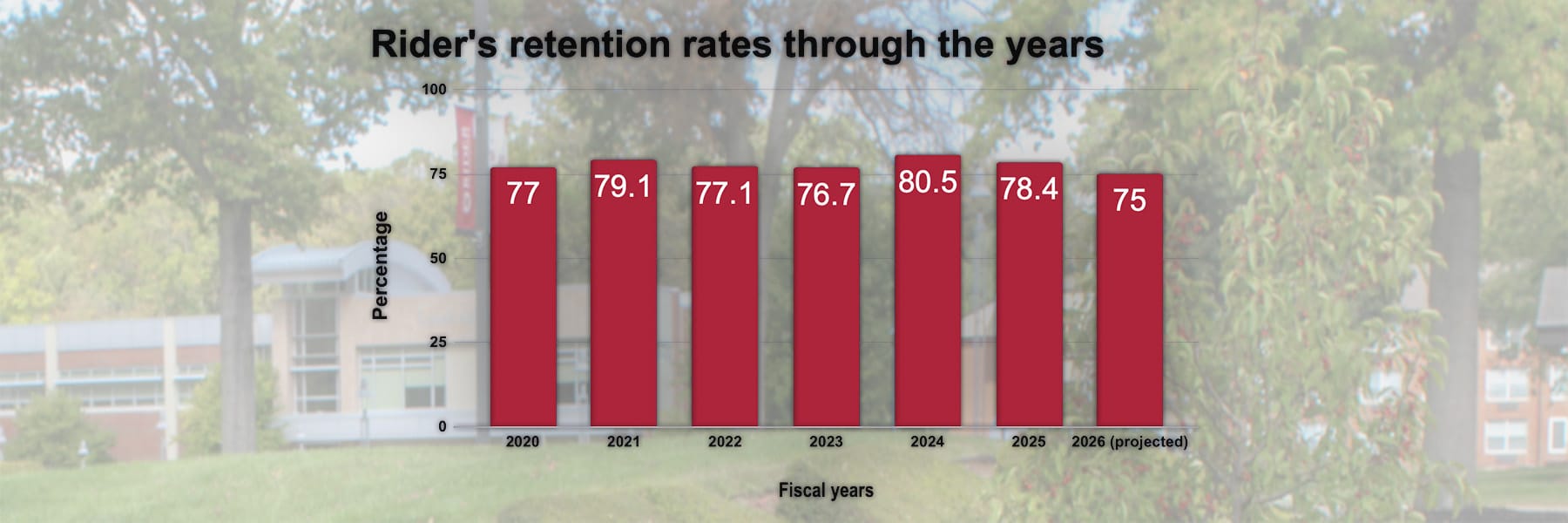
This school year, Rider reported 3,052 undergraduates and a 75% retention rate, which the Plan states is pending the final fiscal 2025 audit. These statistics were collected from an annual census taken on Oct. 1 — a sharp deviation from the past 10 years where enrollment data was announced at the start of the school year.
“We’re still bringing in pretty healthy incoming classes, not what they were, but pretty healthy incoming classes. We’re also the highest-priced institution in our region,” Loyack said at the faculty and staff forum.
The base cost of tuition for the 2025-26 academic year without accounting for room and board was $41,700, according to Rider’s website.
Rider currently has a federal composite score of 0.08, and according to Papa, “the last time [Rider] was at the acceptable range was five years ago.” A federal composite score is used by the government to rank universities in their ability to draw in federal aid for students, with the acceptable range being 1.5 to 3.

Rider President John Loyack’s March to Sustainability Plan rallied support by some, but many faculty members are facing hardship as a result.
Layoffs and concerns
The Plan pledged to eliminate several senior positions in order to “streamline” the administration. On the week of Nov. 17, the profiles of two high-ranking leaders were abruptly removed from Rider’s web pages — Vice President for Enrollment Management Drew Aromando and Vice President for Student Affairs Nick Barbati.
Director of Communications Rachel Stengel declined to comment, stating it was a personnel matter.
Since April, the university has lost several other key leaders, including former Provost DonnaJean Fredeen, former Chief Diversity Officer Heeyoung Kim, former Chief Financial Officer Jim Hartman and former Assistant Vice President of Career Development, Engaged Learning and Leadership Kim Barberich.
Through 35 to 40 faculty layoffs, 14% reductions in salary, suspensions of the retirement match, changes in faculty workload and reductions in faculty benefits, the Plan is set to reduce labor expenses to make up 50% of revenues, which is an 11% decrease from where it currently sits.
“If I were to take the plan as to where we were today to a banker, he would laugh at me because we’re running out of cash … That’s why these actions have to be taken today,” Loyack said at the forum. “I know you feel anger because I felt anger. And I know you feel like people weren’t transparent in the past, because they probably weren’t, right?”
During the Q&A portion of the forum, several employees called for colleagues to support Loyack and the Rider administration in their Plan, in an effort to save the university they have called home for years from closing down.
Director of the Educational Opportunity Program Reggie Walker, one of the staff members to speak up during the Q&A portion, said that members of the Rider community need to stick together through the university’s financial troubles. He said, “We’re out here talking bad about our university in public and then we’re expecting people to come here and want to bring their children here … If you’re part of the problem, and if you don’t see that Rider is going to change, and if you don’t believe in this place, respectfully leave.”
Other employees urged for further transparency from the administration, with one faculty member, who did not state his name, stating “I’ve been here for 11 years. The things I heard earlier, the new academic programs, refreshing the dorms, the previous administration suggested the same things.”
A look back
Former President Gregory Dell’Omo had initiatives of his own that helped raise funds for Rider during his term, a key one being the capital campaign Transforming Students — Transforming Lives, which raised $24.7 million for the university, according to the Plan.
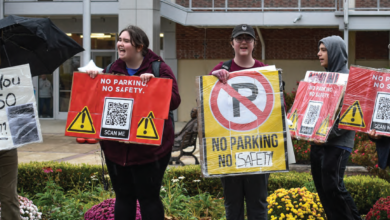
Outlining past revenue enhancements and cost reductions made since fiscal year 2021, the Plan also reported other initiatives, including increases in parking fees, the addition of a digital course material program and an estimated 5% increase in tuition and boarding costs.
According to the Plan, the university also benefited financially from several changes in the last five years, such as $745,000 in additional board and revenue from its partnership with Mercer County Community College, the addition of women’s lacrosse and new academic programs that attracted a total of 168 enrolled students.
However, none of those initiatives were enough to save Rider from deep financial distress.
Several cost reductions were also outlined in the Plan, including ones made in the student employment budget, the operating budget and the retirement contribution. A total of 10 graduate assistant positions were eliminated and hours reduced for undergraduate student workers in fiscal 2025. The campus shuttle students utilized for transportation between the Lawrenceville and Princeton campuses was also discontinued through fiscal 2026, saving $35,000.
A total of $700,000 is also projected to be cut in fiscal 2026 through the elimination of technology expenses and reductions in advertising and marketing. Additionally, Rider renegotiated a number of key contracts with third-party services, including food services, custodial services and mailing, print and packaging services.
Outlined in the Plan are several position eliminations and salary reductions for employees under Rider’s chapter of American Federation of State, County and Municipal Employees. In total, 179 vacant positions were eliminated, 79 occupied positions eliminated and five were reduced from full-time to part-time, saving an estimated $16.2 million across the years.
Co-President of AFSCME Victoria McLendon told The Rider News that the union has discussed alternative options for its 38 members other than 14% base pay reduction that the Plan calls for. She said, “We have lost our employees and our workloads have shifted. No different than what’s expected of [the AAUP]. And fairness to them, it’s their turn for this hit.”
Since the release of the Plan, the Alumni Board of Directors and the Norm Brodsky College of Business Executive Advisory Council have shared support for the Plan. Loyack also met with the Student Government Association on Nov. 14 to further discuss the Plan, resulting in SGA endorsing the Plan through a Nov. 17 universitywide email.
“We believe this plan proposes the necessary steps to address Rider’s financial crisis, with the utmost care and consideration to the student experience,” the SGA email stated. “We understand the implications that the proposed cost-saving measures may have on faculty and staff, and we recognize that this may not be ideal for some. However, considering the severity of the situation, it is necessary for all members of the Rider community to unite and recognize that these are temporary sacrifices for long-term sustainability and growth.”
A student forum will be held on Nov. 20 between the administration and students, with a separate webinar taking place on Nov. 19 for curious and concerned parents.
SGA President Moira Geiger told The Rider News, “I think that by giving the plan a further look, it can help resolve any misconceptions or general questions. The forum is a great way to get further clarification on anything that might not have made sense … I believe that when we share messages of concern without any messages of trust and belief, we are only harming the Rider community that has done so much for us.”