“Jesus Christ Superstar:” finding humanity in the holy
By Samantha Clark
There is something profoundly evocative about watching a story with a familiar ending. In a story defined by tragedy, it is not simply because of the central figure’s ultimate fate, but rather, because of the inability, or unwillingness, of those around him to stop it.
Rider’s production of Andrew Lloyd Webber and Tim Rice’s “Jesus Christ Superstar” lit the Yvonne Theater on Oct. 23 through 25, taking the almost-full house on an emotional rollercoaster. With laughter through song and dance, paired with heartbreak through means of hesitation, betrayal and the ultimate loss in the Passion of Christ, the cast and crew breathed new life into the story of the crucifixion, transforming the well-known ending into an unforgettable theatrical experience.
Before we get more into this awe-inspiring performance, I want to first address the controversy that often surrounds this show. For some believers, placing Jesus’ final days on a stage, paired with elaborate costumes and choreography, comes off as offensive to their sacred story. However, as a Catholic myself, I saw it as an opportunity for this great tale of faith to be shared to audiences who are unaware of its significance. Rather than viewing the intersection of art and religion as disputable, it is worth viewing the stage as a medium for faith, as it allowed this centuries-old story to be spread to new audiences. The production did not diminish the sacred nature of the narrative, but instead, invited all to experience the message in their own way.
With that being said, going into this production, I obviously knew the story of Jesus’ final three days, but I was unfamiliar with the pop-rock musical itself, allowing every song and character choice to bring a fresh perspective. Specifically, Rider’s production was adapted to reflect the peaceful period of the 1960s, and with that fresh perspective came such awe and amazement, pushing me to attend not once, not twice, but three times over the course of the weekend.
Of course, this show stars powerful main characters, with Jesus of Nazareth, played by junior musical theatre major Danny Hanna; Judas, played by senior musical theatre major Nia Chavis; and Mary Magdalene, played by senior musical theatre major Alexis Archer, carrying audiences through the 90-minute plot. However, it must not go unsaid that the production’s ensemble truly made this show what it was.
The 11 faithful Apostles, most notably Peter, played by senior musical theatre major Julia Almendra, and Simon the Zealot, played by junior musical theatre major Jaide Fisher, as well as the Disciples, brought such light to a seemingly devastating story.
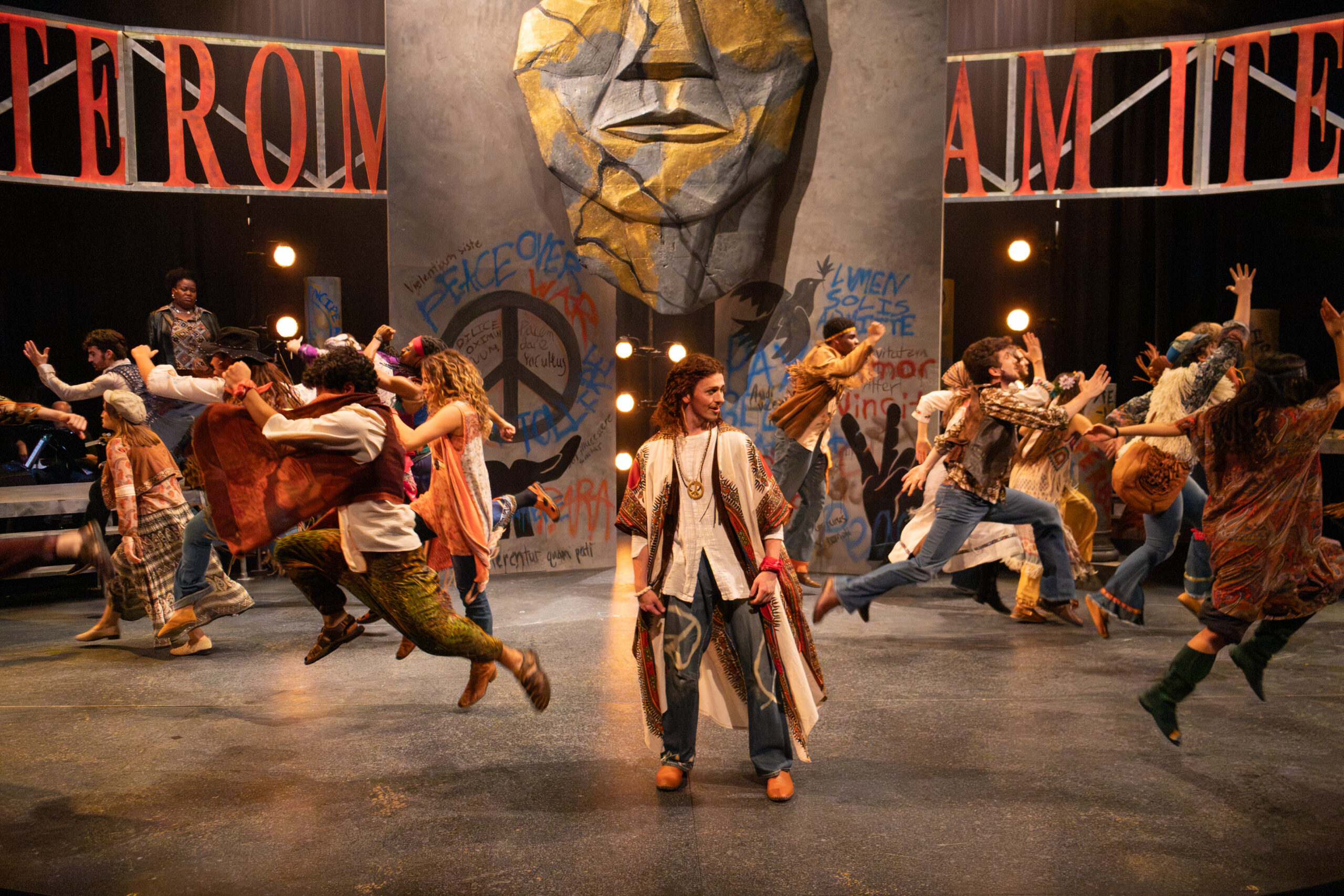
The first song to feature these characters, the third overall and my personal favorite, “What’s the Buzz?,” accurately depicted the infatuation of Christ to audiences, allowing everyone in the theater to truly feel the love shared amongst the people of the Holy Land. As the mood dimmed and the story progressed, the ensemble seamlessly shifted this joyous and celebratory energy to that of solemnity and regret, bringing a tear to my, and several other audience members’, eyes each night.
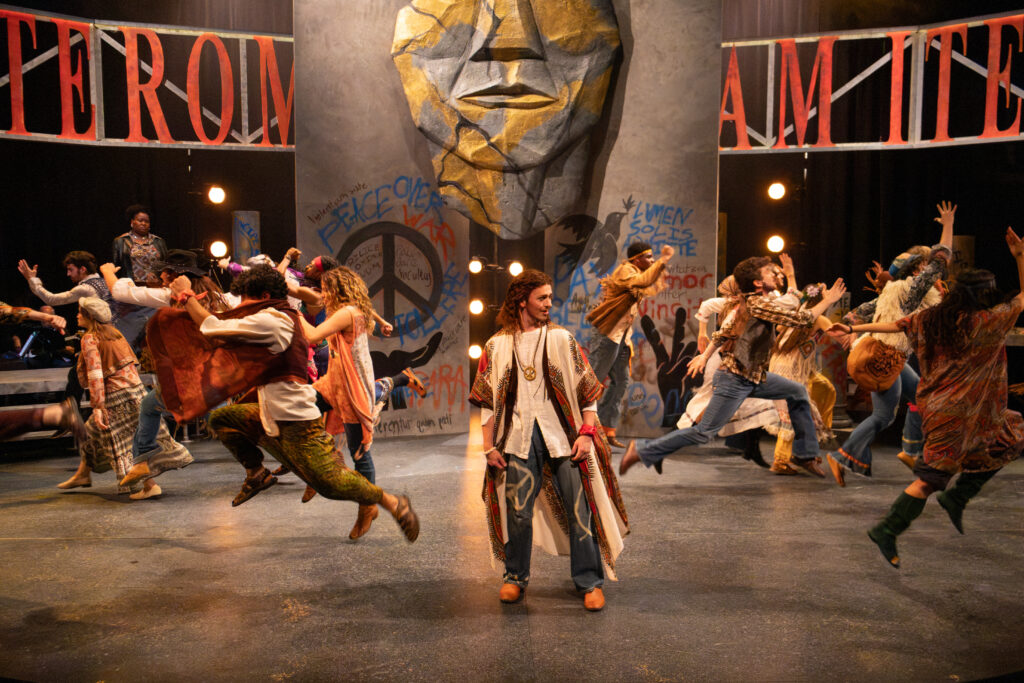
Photo by Abby Ray
After the “buzz” of introductions, the direction of the performance did a commendable job at developing the on-stage characters into relatable people. Archer’s portrayal of Mary Magdalene was that of perfection, as she so easily adapted the otherwise tormented character into a figure of peace on Earth. Her voice, stature, wardrobe and all-around “vibe,” for the lack of a better term, created a sense of calm, which was exactly what she stood for opposite Hanna’s Jesus.
Similar to the sudden switch in Act 1 from community to alienation, we can not move any further before taking a moment for the spine-chilling depiction of Caiaphas by sophomore acting major Gavin Evanson — yes, you read that right, sophomore. If you had the great pleasure of sitting in the audience, the observance of Evanson’s pure talent was one of a kind.
His portrayal of what eerily represented that of the Devil was what I would call one for the Rider history books after attending almost every mainstage performance as a student. There were moments when I found my mouth physically agape at his ability for staccato movement, deep-bass range, personal interactions and facial expressions for the entire production, even when he was hiding creepily in a dark corner. I greatly commend Evanson for this top-notch performance, as he was truly something special in his Rider mainstage debut and left me thinking about this character well after exiting the doors of the Yvonne.
Other evidently villainous characters, including junior music major Cameron J. Krauss’ King Herod and senior musical theatre major Jessie Doty’s Pontious Pilate, furthered this contrast that perfectly balanced comedy and cruelty. While eliciting laughter when planning the ultimate sin of crucifixion, these characters showcased the ease with which human suffering can be transformed into an entertaining spectacle.
Whether characters believed him to be “the King of the Jews” or “just a man,” one thing was undeniable: Hanna’s portrayal of Jesus was talent placed under a spotlight. His opening interactions with those who viewed him as God blended so fluidly with the slow progression of disloyalty by those same characters, bringing such devastation to audiences when his ultimate demise was projected on stage.
Throughout Act 1, Hanna’s vocals in “What’s The Buzz?” and “Hosanna” began extremely upbeat and praise-like, and as the plot began to slowly grow dim with sin, so did Hanna’s tone. “The Temple” scene shifted audiences to a completely new setting, one where faith was actively disappearing before our very eyes. Act 2 featured “Gethsemane,” a song that is widely considered to be one of the most challenging songs in all of musical theater. However, you would never be able to tell this by Hanna’s seemingly easy ability to carry each melody while also packing emotion in every lyric, riff and note hold, including one that lasted a whole 19 Mississippi’s — yes, I counted. This song marked the pivotal moment before Jesus was put to death, where Hanna perfectly exemplified the internal struggle of balancing faith with such a great level of anguish.
From his opening walk through the archway that centered the stage, to his last words on the cross, Hanna brought sentiment to every glance, breath and moment of silence, transforming the familiar biblical story into a heartbreaking portrayal that remained captivating long after the final bow.
And now, it is time to delve deeper into Chavis’ character of Judas, the unfaithful apostle, for they brought the character into a heart-shattering darkness, reflecting the work of a true professional. Throughout the entire production, there was this underlying, unsettling energy in their facial expressions and body language. Whether center stage or simply sitting off to the side, Chavis never broke from the personification of regret, even before betraying their “right-hand man.”
Their powerhouse of a voice and the ability to punch emotion in every syllable contributed to their magnetic stage presence that made me physically lean forward in my seat. However, absolutely nothing in this production could top the scene of “Judas’ Death,” where their undeniable greatness genuinely took my breath away. If this performance is any indication of what is to come, I can predict great things for Chavis, whose performance was nothing short of a masterclass in talent.
In a story where friendship is fractured by doubt and betrayal is shaped by anguish, the cast and crew of Rider’s “Jesus Christ Superstar” transformed a tale as old as time into an achingly-human tragedy, bringing the true magic of theater to the Yvonne.
Samantha Clark is a junior communication studies major
Social Media Editor Mallory Hoelzl was a sound operator for the production of “Jesus Christ Superstar.” Hoelzl had no part in the writing or editing of this story.