Rider hosts 44th annual Gender and Sexuality Studies Colloquium: ‘We’ve always been here’
By Caroline Haviland
The 44th annual Gender and Sexuality Studies Colloquium on April 7 brought together students, faculty and staff in Lynch Adler Hall to highlight the importance of inclusivity and representation through student presentations and a keynote speaker.
The colloquium featured two student panels titled “Considering Gender” and “Gender & Queer Theory in Policy, Athletics & the Arts.” Each panel consisted of four student presentations that included topics like gender differences, queer theory and reproductive healthcare.
Director of the Gender and Sexuality Studies Program Erica Ryan led the colloquium through its numerous elements, as well as presented the two awards of the day.
Justin Burton, a music professor, was given the 2026 Ziegler-Gee Award, which “honors faculty, staff and administrators who have demonstrated exemplary support for gender equality and a focus on ending gender-based discrimination on campus in their work and in the community,” Ryan said.
The 2026-27 Virginia J. Cyrus Scholarship was awarded to junior sociology and English major Carole Cobos, Ryan said, for her works that feature feminist and psychoanalytic analysis. It included a criticism on the nature of the patriarch in “Pride and Prejudice” to comparative research on Indigenous feminism in Latin America.
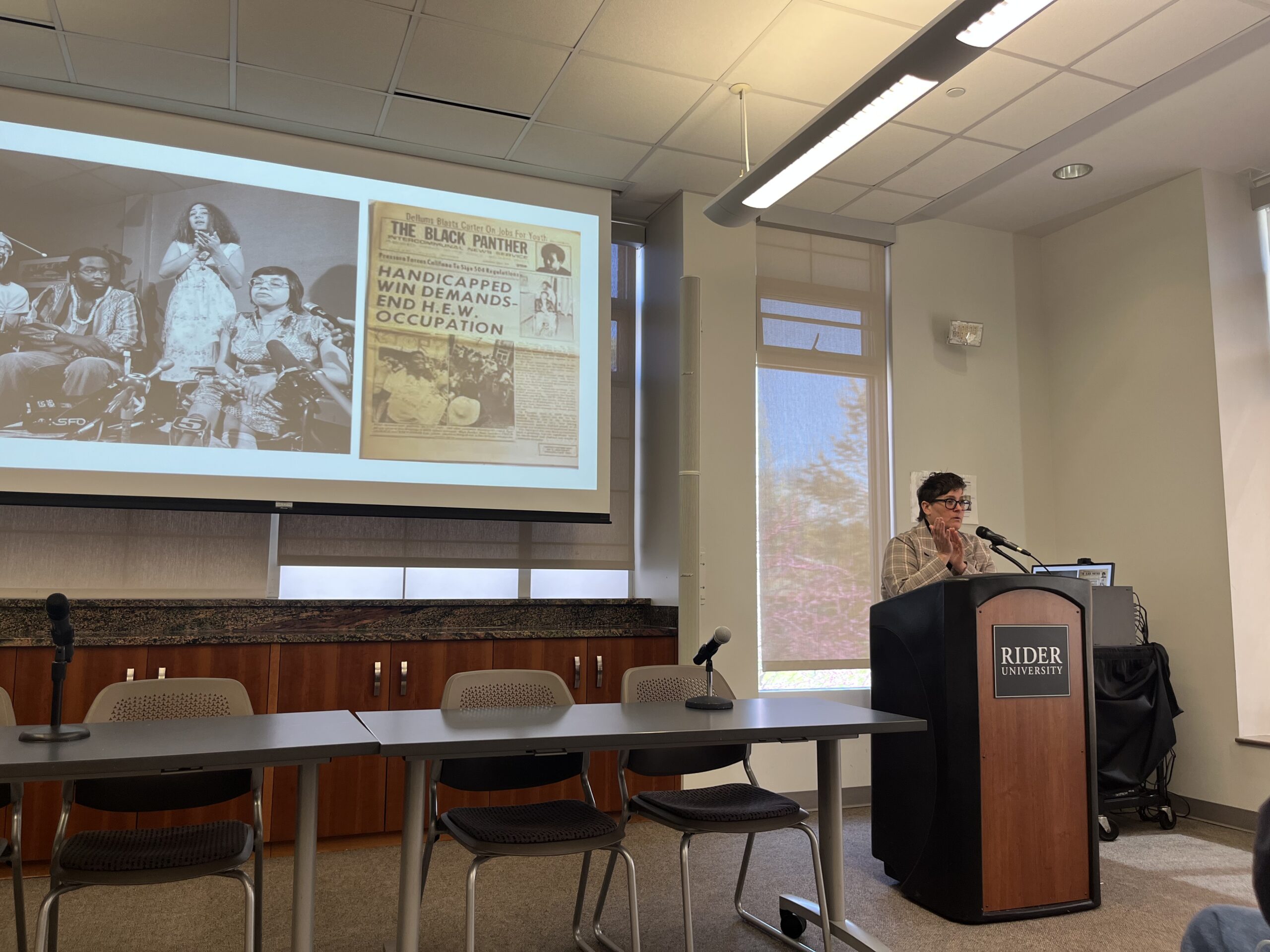
The mid-point of the event welcomed in Kate Okeson, the colloquium’s keynote speaker, who delivered an address titled “We’ve Always Been Here: LGBTQIA+ Histories, Figures and Contributions Inclusive Pedagogy and Why it Matters.”
Coming from an educational background of 27 years as a public school teacher, Okeson currently serves as executive director of the LGBTQIA+ youth equity commission at the New Jersey Department of Education, where she works to empower educators and school leaders to implement New Jersey’s LGBTQIA+ inclusive education mandate.
At the start of her lecture, Okeson shared a story from a time in her youth when she came across a documentary called “The Celluloid Closet,” which gives a historical account of LGBTQIA+ cinematic visibility in Hollywood over the first century of the moving picture.
“It gets into how characters who were not heterosexual and not cisgender were handled in those films … They had to have some sort of unhappy outcome. It wasn’t until the 1970s where there was at least a modicum of positive visibility around queer and noncisgender popular figures,” Okeson said.
Drawing on that point, Okeson’s address extensively explored the necessity of LGBTQIA+ and transgender visibility in the classroom, specifically pertaining to the subjects of history and literature.
“A big chunk of history is certainly context and inquiry … Historians and educators will often answer a question of why or what is the point of it with, ‘Well it makes for good history,’” Okeson said. “But we can’t just leave that only up to the historians. So we want to move history from that story of war, specific people in power, to a more complex depiction of all the ways that we in society are part of that history.”
Offering an example, Okeson shared that the first gay-straight alliance is typically identified as taking place in 1989. However, the earliest record of such a group dates back to 1972 in Washington Heights, New York City, when high school students got an administrator and a teacher on board to join a movement concerned about the intersection of race, gender and ethnicity.
“The reason that there is one group that got named as the GSA being the first one for so long, and if we investigate it, is that it is a very white, very high level socioeconomic, private school. What did they have access to? Not only a means to make and communicate, but save to archive the historical record,” Okeson said.
A majority of the address was also spent presenting creative pieces that reinterpret famous paintings, such as the painting of Napoleon crossing the Alps. The appropriation, painted by Kehinde Wiley, featured “an unarmed contemporary Black man, with neoclassical elements,” Okeson said.
In the original, Napoleon is riding a horse through the Alps into battle. However, Okeson clarified that according to historical accounts, Napoleon actually rode on a mule long after his other soldiers left.
The purposeful visibility of specific figures in history and the hiddenness of others with intersecting identities was a part of the message Okeson set out to convey. The classroom, Okeson explained, should be a place where those figures are brought to light for future generations to learn about.