The 25th anniversary of an American tragedy
By Cal Sutton
Students, faculty and administrators alike gathered at the entrance of Moore Library at 12 p.m. on Sept. 11 to honor the lives of those lost in the terrorist attacks that occurred on Sept. 11, 2001.
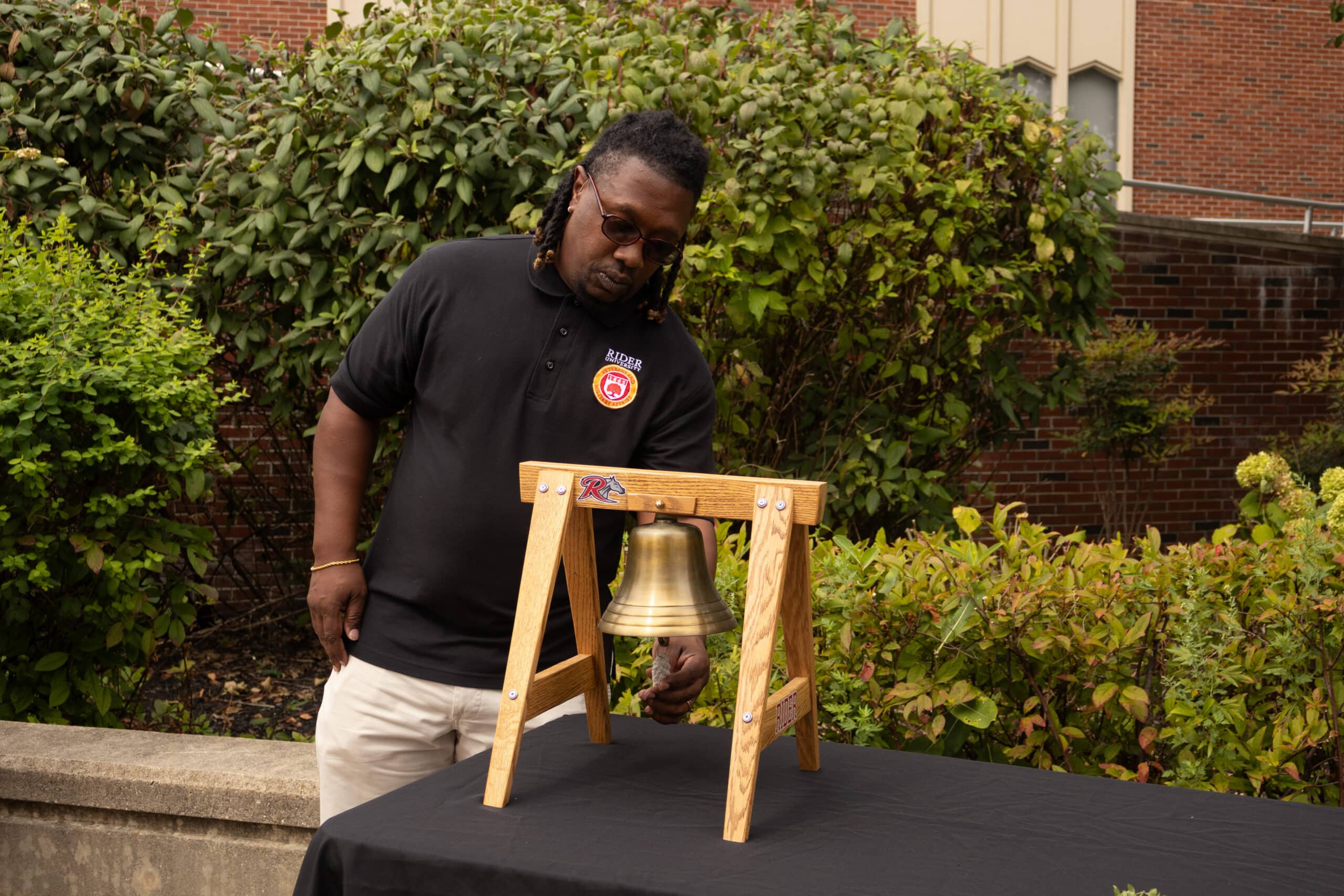
The Dr. Eugene Marsh Center for Veteran and Military Affairs and the Center for Community + Belonging organized the event, held annually to pay homage to the many lives impacted, with a portion of the lives lost being members of the Rider community.
Of those lost on 9/11, eight victims were Rider students, faculty or staff members. Lawrenceville campus victims include Kenneth Ledee of the College of Continuing Studies; Gary Lutnick, ’87; Domenick “Mosh” Mircovich ’83; Ferdinand “Fred” Morrone, ’77; Thomas Regan, ’80; Alison Wildman, ’93; and Kenneth Zelman, ’86.
From Princeton’s campus with Westminster Choir College, the Rider community lost Mary Yolanda Dowling, ’81, on 9/11.
The attacks that occurred on Sept. 11, 2001, shook the United States to its core. It was a normal morning to most, until 8:46 a.m.
Terrence Bolton, interim coordinator for community engagement + belonging, also oversees the Dr. Eugene Marsh Center for Veteran and Military Affairs. He was a part of the ceremony to commemorate the lives tragically lost for 9/11’s 25th anniversary.
“The importance of remembering 9/11 is to remember those who have sacrificed themselves for the better good of others,” Bolton said. “9/11 united a nation through challenges, where differences were put aside which allowed the country to become one, we must remember that in times of despair no one is greater than the other.”
The 9/11 terrorist attacks on the World Trade Center, the Pentagon and the diverted plane in Shanksville, Pennsylvania stirred immense fear for Americans, but in that, brought people together.
The people impacted by 9/11 also go further than those who lost their lives in the three plane crashes. Regular people, who were entirely uninvolved with the cities or people whose lives were tragically lost, also felt the repercussions in the days and years after.
Micah Rasmussen, director of the Rebovich Institute for New Jersey Politics, was not any different. He was having a normal, if not, peaceful morning, until he heard the news.
“The southernmost stretch of the Garden State Parkway made for a glorious end of summer drive 25 years ago,” Rasmussen said. “I was returning tables and chairs that we had borrowed for Jeff Van Drew’s giant yearly pig roast at his house. The radio on the dashboard brought the awful news.”
The morning of 9/11 was ordinary to many, but thousands of lives were torn apart following the initial attack. Even if people were not in the target cities and did not know anyone who was killed in the attacks, the pain was felt across the United States.
“It’s hard to find a town in New Jersey that wasn’t profoundly impacted or lost people,” Rasmussen said.
The attacks on Sept. 11, 2001, may also feel somewhat detached to college students, as many individuals enrolled in colleges are aged between 18 and 24 years old, on average. This means many students do not have any memory of the attacks, with the only knowledge they have being what they learned in school and from individuals telling their stories.
Lizbeth Ortiz, a senior human resource management major, is the student body president for Rider’s Student Government Association and read out the names of Rider community members who lost their lives in the attacks.
“I feel so many different emotions,” Ortiz said. “I wasn’t born, and I probably wasn’t a thought in 2001, but I still carry their words and memories.”
25 years later, the country is united in grief and remembrance of those whose lives were lost, as well as a sense of strength that as a country, the United States is resilient through the worst of situations.
Bolton said, “9/11 is a symbol that we as a country can remember that in times of need, there is no color, gender or religion greater than humankind.”