Behind the seams: “The Threepenny Opera” costume production
By Dawinie Daphca Registre
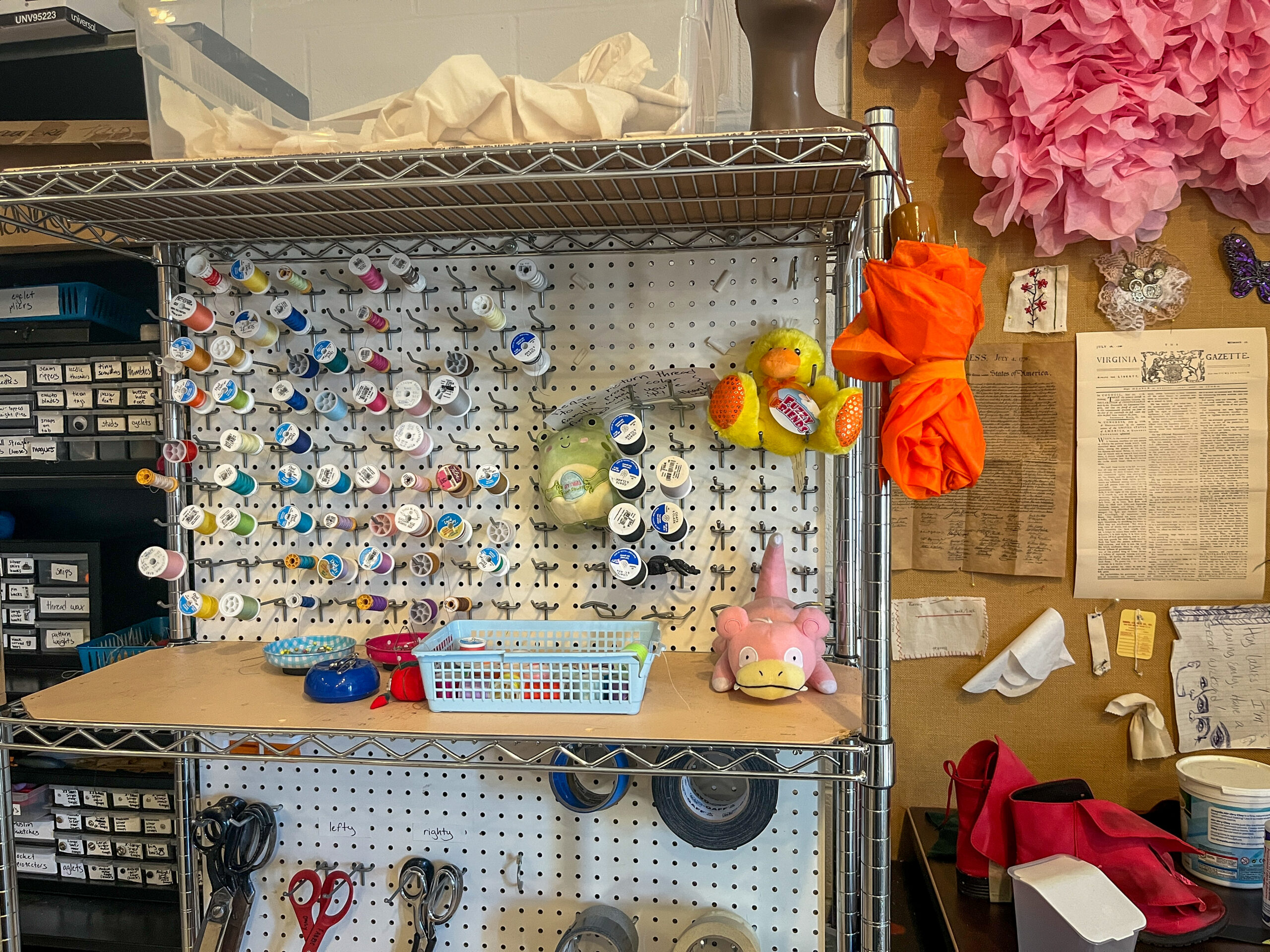
Colorful threads hang beside each other. Bright reds pop out next to dark blues, which drown out next to bright yellows. At each table sits a sewing machine ready to be threaded and punctured through fabric. Alongside them, patterns are pinned to the wall. At Rider’s costume shop, sewers and designers gather together to produce pieces for the upcoming production of “The Threepenny Opera.”
Adapted from John Gay’s 1728 “The Beggar’s Opera,” the play is set in mid-19th-century Soho, London, and is by Bertolt Brecht and Kurt Weill in collaboration with Elisabeth Hauptmann. Character introductions unravel themes such as love, corruption and a struggle to hold power, but their clothing reveals a story before their actions do.
The mind forms a preconceived notion before a character speaks. Why? Clothing shapes how a character is perceived, as it reveals social class, motives and mood.
A creation starts with a vision, and this requires meshing everyone’s individual talents to create one cohesive piece.
Jim Parks, the shop supervisor, costume shop manager and adjunct professor, aids in bringing these theatrical visuals to life. He stated his purpose is “To fill the vision that Robin [Shane] has, that has been developed with the rest of the production team and the director.”
Robin Shane, an associate professor of theatre, leads the inspiration for the production designs. While Parks is not the designer for the production of “The Threepenny Opera,” his work on previous productions, such as “RENT” in 2024 gives insight into how a director’s vision shapes the design.
The award-winning costume designer explained he develops his ideas based on the world the director wants to construct. He takes into consideration how these designs align with the overall vision seeking to be portrayed. Parks explained, “Whether that be a change in historical setting or a broad concept that we’re trying to get across by using color or shapes.”
Once this concept has been established, the design process is started. Alongside him, costume shop employee and senior musical theatre major Julia Almendra aids in bringing the garments to life.
When sourcing the fabric for these garments, Almendra explained that the production’s garments are secondhand items. They stated, “We go thrifting a lot, and we also get donations sometimes.” This method has shown to be more affordable and sustainable.
Since the play is based in the 19th century, the team’s search for material was difficult. Almendra shared that it was difficult to find pieces that cater to the time period, voicing that, “Threepenny was a little bit harder because it’s a period piece, so for a lot of it, we’ve had to upcycle and make.”
Color, shape and texture: every layer, fabric and stitch is an element that aids in painting a picture with no words. Each piece adds to another complex theme within the story. Almendra shared that some materials that will be used in the production include mesh and tulle. They went into detail about how the use of this material helps in portraying a specific visual on stage, stating, “Lots of mesh and tulle because of the big, flowy gowns.” The use of this material will aid in enhancing the movement of the garment on stage as actors perform.
In this production, audiences will be seeing detailed embroidery displayed on corsets. These decorative features serve a purpose. Almendra expressed that they chose these materials, “Because we knew that, in the lighting, they would shine really nicely.”
What begins as just a collection of elements ends as a cohesive art piece. On stage, colors carry emotions, and structure creates depth. Fabrics may move, or stand still, caging a character in a non-existent barrier. Behind those seams lies a team of people who work to bring an identity to audiences.
Rider’s production of “The Threepenny Opera” will open on Nov. 20, with shows running until Nov. 22. Tickets are available online at Rider’s Box Office.